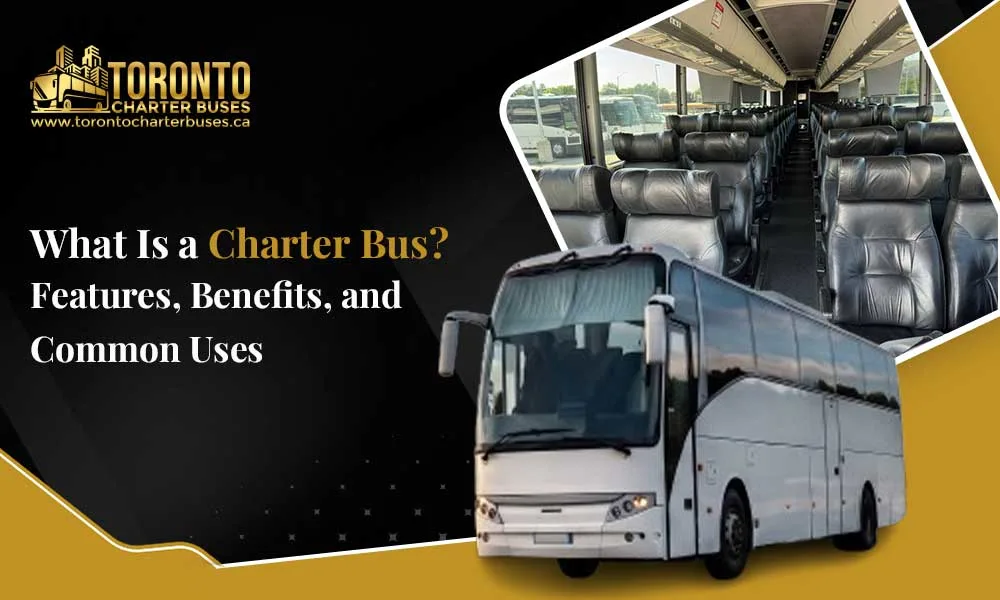
A charter bus is a large passenger vehicle, typically holding 20 to 56 people, that a group rents privately for a single trip with a professional driver included. Unlike a city transit bus, it doesn’t follow a public route or stop for strangers. Your group sets the pickup point, destination, and schedule, and the vehicle is yours for the entire booking.
That distinction, private and exclusive rather than shared and fixed-route, separates a charter bus from a transit bus, a scheduled intercity coach, or a rideshare fleet. Keeping that in mind makes it easier to pick the right vehicle for your trip.
The term is a category defined by how the booking works, not by one specific vehicle:
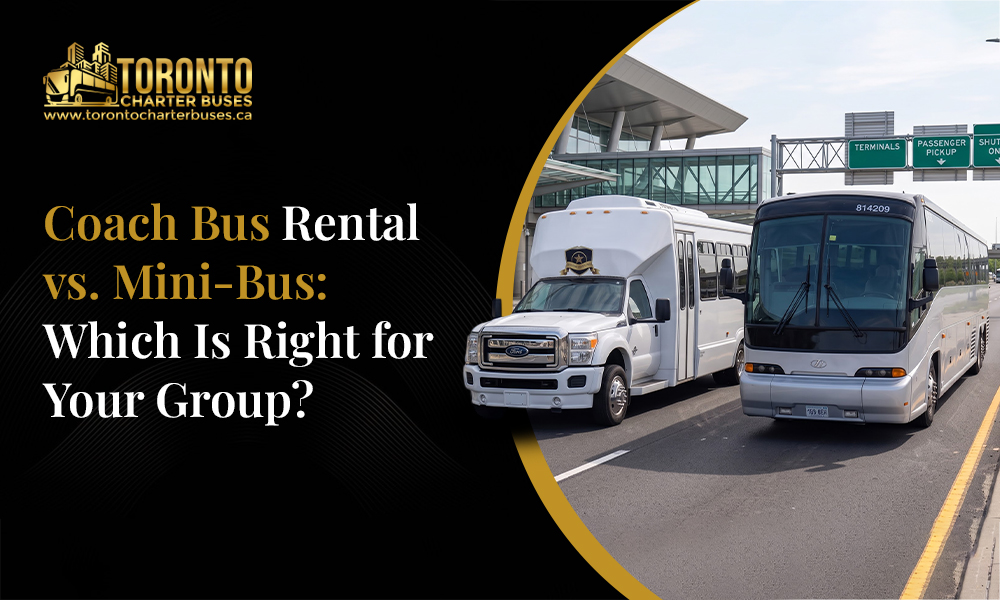
Coach Bus: A full-size motorcoach with 45 to 56 seats that is designed for longer trips and has luggage storage underneath.
Mini Bus: Roughly 20 to 28 seats, suited to short trips or tighter budgets.
School Bus: 25 to 48 seat configuration, commonly used for student transport.
The right vehicle comes down to passenger count and trip length. A 15-person office outing doesn’t need a 56-seat coach, and a multi-hour trip isn’t comfortable in a mini bus.
| Mode | Controls the route | Shared with strangers | Group size |
|---|---|---|---|
| Charter bus | Your group | No | 20 to 56 |
| City transit bus | Fixed public route | Yes | No exclusivity |
| Scheduled intercity coach | Fixed schedule/stops | Yes | Individual tickets |
| Rideshare fleet | Individual trips | No, but split across cars | 1-4 per car |
A charter bus is the only option where one group gets one vehicle, one driver, and full control of the itinerary, without splitting into several cars or sharing seats with the public.
Fleet quality varies by operator, but a well-maintained coach or mini bus typically includes:
This is worth answering with real numbers, since it’s the question parents, event planners, and corporate travel coordinators care about most.
Buses have been more than 70 times safer than passenger vehicles per 100 million passenger miles over the past decade, per the National Safety Council.
Children travelling to school by bus are 72 times safer than those travelling by car and 45 times safer than walking or cycling, according to Canada’s National Collision Database, as reported by School Bus Ontario.
The calculation varies depending on the size of the group, but the general trend is that one shared vehicle is more advantageous than multiple private vehicles or ridesharing trips when the group size is larger.
Toronto adds a local reason. TomTom’s 2025 Traffic Index ranked Toronto the second most congested city in Canada, behind only Vancouver, with drivers losing roughly 100 hours to rush-hour delay over the year, nearly four hours more than in 2024. For a group heading to a conference, a wedding venue, or Pearson Airport at peak hours, that congestion applies whether it’s one car or five. A charter bus doesn’t erase the traffic, but it does mean one driver absorbs the stress of navigating it instead of several drivers doing the same route separately and each hunting for parking on arrival.
For corporate groups tracking sustainability goals, the efficiency numbers favour buses by a wide margin.
Coach buses average 195.3 passenger-miles per diesel gallon equivalent, ahead of passenger vans at 97.4, per American Bus Association research using Texas A&M Transportation Institute data.
Motorcoaches emit roughly 53 grams of CO₂ per passenger-mile, versus 106 grams for passenger vans, per the same ABA analysis.
Spreading one engine’s fuel burn across 40 to 50 riders uses far less fuel per person than the same group driving separately, which is the core reason buses outperform personal vehicles on emissions per passenger.
Charter buses show up in more situations than people expect, mostly because moving a group together on one schedule applies to nearly any gathering.
The data points one direction: buses have a significantly better safety record than personal vehicles and use fuel more efficiently per passenger than most road transport. Additionally, they address a logistics challenge by keeping a group together on one schedule, something cars and rideshares cannot achieve.
None of that removes the need to verify who you’re booking with, and it’s why we’re upfront about the details before you commit. At Toronto Charter Buses, we own and maintain our own fleet, our drivers are licensed and experienced with GTA and cross-border routes, and we’ll walk you through various charter bus options, pricing, and availability before you sign anything. That transparency is a big part of why groups across Toronto and the surrounding area come back to us trip after trip.
If you’re planning a trip and want to compare bus options, routes, or pricing for your group, get an instant quote from Toronto Charter Buses, and we’ll help you find the right fit.
A charter bus is a large passenger vehicle, usually seating 20 to 56 people, rented privately by one group for a specific trip. It comes with a professional driver included, and the group controls the pickup point, route, stops, and schedule, unlike a public transit bus or a scheduled intercity coach shared with strangers.
Statistically, yes. National Safety Council data indicates that buses have been more than 70 times safer than passenger vehicles per 100 million passenger miles over the past decade. However, the maintenance history and driver education still play a major role in trip safety.
Capacity depends on the vehicle type. Full-size coach buses typically seat 45 to 56 passengers and suit larger groups or longer routes. Mid-size mini buses hold roughly 20 to 28 people, a better fit for smaller parties.
To get the best selection of buses, make sure that reservations are made in advance at least 1 month ahead. During wedding season, graduation days, major sporting events, or holiday weekends, when demand increases and popular buses and time slots get reserved quickly, make reservations at least a month in advance.
Yes. Our Ontario-based charter operators run cross-border routes into New York State, including destinations like Buffalo, alongside standard travel across the Greater Toronto Area. Passengers should confirm passport or documentation requirements with the operator well ahead of the trip, since border crossing rules can change and affect scheduling.
A charter bus is booked exclusively for one group’s complete itinerary, from pickup to final drop-off, with no fixed schedule. A shuttle service typically runs shorter, repeated transfers, such as between a hotel and a venue or an airport and a parking lot, often on a semi-fixed loop or timetable.
Yes, always. A licensed, professional driver is included as standard with every charter bus rental. Passengers are never expected or permitted to operate the bus themselves, which is part of what makes charter travel lower-stress than coordinating multiple personal cars or shared rides for the same group.